Game Dev · · 6 min read
Edge of Space, Part Two: The Map I Should Have Drawn
The game design document that rescued Edge of Space, my OGAME inspired game, a systems map, MoSCoW in practice and the few numbers that quietly run all of it.
Current state#
In the last post I showed you my deep and careful planning for my game Edge of Space, those two example pages joined the hundreds of post-its and scrap bits of paper I had on my desk. Now its time to see what they became and likely should have started as.
What is a Game Design Document actually for?#
A game design document is a detailed guide used to communicate the core ideas, features, and mechanics of a game project to the development team. Sometimes this will be the first document you will write and it will contain all your ideas and thoughts for your game. Other times such as my journey with Edge of Space this is a document you create when you realise that the project is too big to keep it all in your head.
If I had written this document at the beginning it would have been complete fiction as at that point I had no idea what parts of the game were important.
The issue here is that the game design document is a crucial part to most if not all games. Over the years I have created 15 games some just for the children when they were young and others for friends or even just myself. A lot of these games did not have a game design document they had an idea and scope that was small enough to not need a game design document. So when does the scale of the game dictate it needs a GDD?
Scale of work.#
Games like Edge of Space and OGame require a GDD as they have multiple systems interacting with each other and without documenting / drawing it out, it can be very difficult to keep track of everything.
Here is one of the first systems map for Edge of Space.
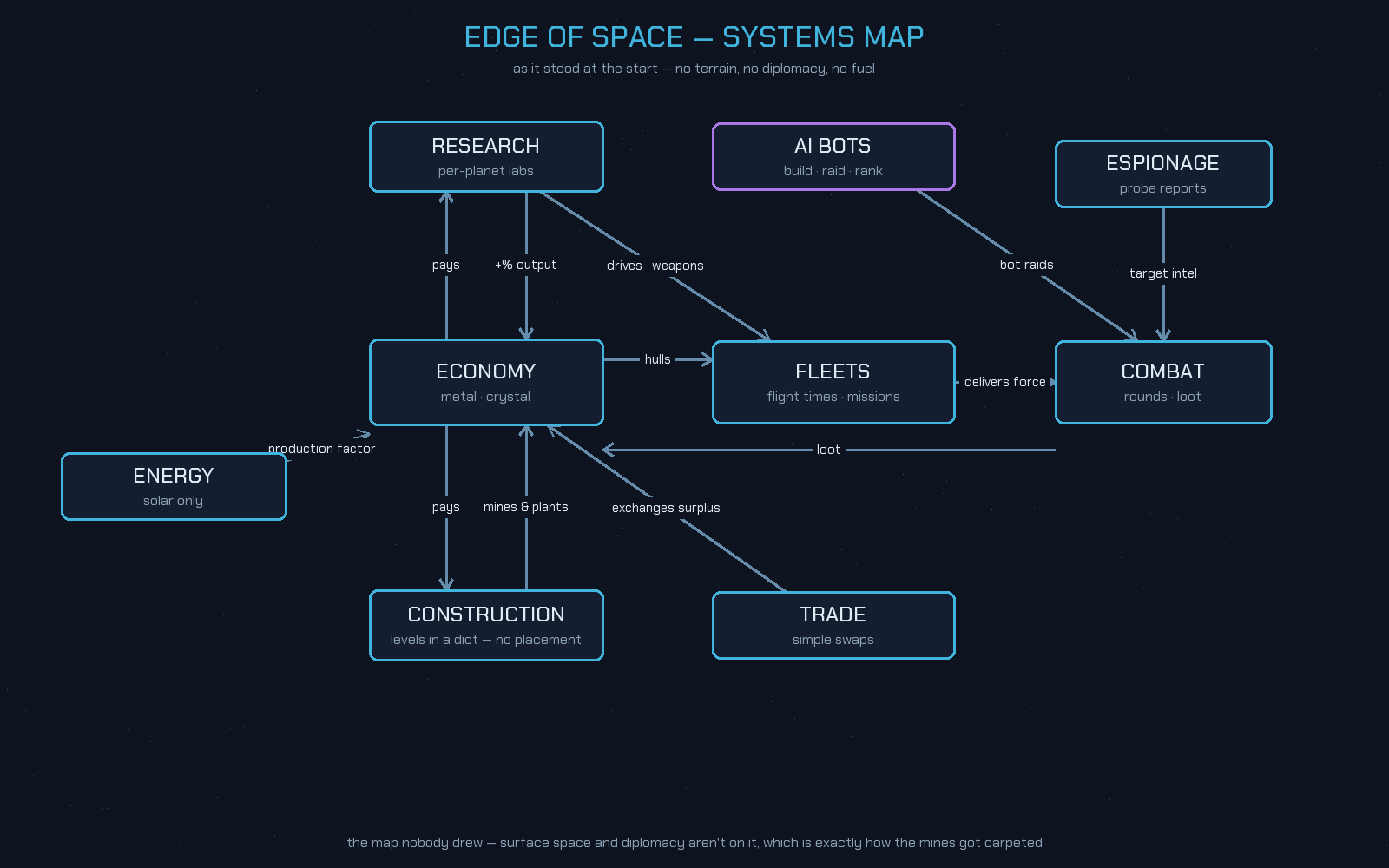
As you can see even at this early stage there are multiple systems working together, each of the systems needs to be aware of interactions and affects. At this scale this shows the need for a GDD otherwise as I found out it gets very difficult to manage and know where to go next.
MoSCoW in action.#
To begin with I wrote down all the systems I could imagine a game like OGame would use and included many that I wanted in my game.
| System | MoSCoW |
|---|---|
| Economy | Must Have |
| Construction | Must Have |
| Research | Should Have |
| Fleets | Should Have |
| Combat | Should Have |
| Trade | Could Have |
| AI Bots | Could Have |
| Social | Could Have |
As you can see this isn't an exhausted list of everything in my game but the key systems and whether we need them. With the core systems identified you can begin to break them down and run the same exercise inside each one. Economy on its own doesn't tell you very much, so it becomes storage caps, offline progress, the cost of placing your second and third mine, and every one of those gets a Must, Should, Could or Won't have yet of its own.
The column I expected the least from was Won't have yet, and it turned out to be the one I use most. Terrain elevation, destructible ground, weather, a fourth resource, they are all good ideas and none of them were the game I was trying to finish that month. Before the document they would rattle around my head for a few days and occasionally win. Now they go on a shelf with a note next to them. Scope creep doesn't need killing, it needs somewhere to wait.
What the list would not do, no matter how neat I made it, was tell me why the game kept breaking. I had an inventory of everything Edge of Space contained and the systems were still quietly fighting each other.
The arrows are the design.#
Look again at that early systems map above, but this time look at what isn't on it.
There is no Terrain box. The Economy is metal and crystal with no fuel in it, the Energy box is solar only, and Construction is described as levels in a dictionary with no placement, because at that point buildings didn't really live anywhere. The planet surface was a picture I drew things on.
That gap is where my worst balance problem came from. With no connection between the ground and the economy the best strategy in the game was to carpet a planet in metal mines, and a player doing that is not playing badly, they are playing correctly. I had built two systems that were both fine on their own and never asked what they should be doing to each other.
The fix wasn't a new feature, it was a line between two boxes. Once mines became physical buildings that use up field points and have to sit on a real deposit, land became a currency and the carpet strategy died on its own. Terrain to Economy, and Terrain to Construction underneath it, two arrows that a feature list was never going to show me.
Once you start hunting for missing arrows they turn up everywhere. Combat to Economy is my favourite of them, loot and debris pouring back out of a fight, which is the entire reason recyclers exist in the game. A war leaves a field of scrap behind it and somebody is going to go and collect that, and if you haven't drawn that arrow you end up staring at your own game wondering why nobody ever attacks anyone.
Every balance failure I have had so far was an arrow I hadn't drawn.
The numbers that run it.#
The last layer of the document was the one I didn't see coming. Edge of Space has hundreds of constants in it and most of them are decoration, you could double them or halve them and it would feel like the same game. Then there is this handful.
| Setting | Value | What it actually controls |
|---|---|---|
BUILD_TIME_SPEED | 2.5 | The tempo of the whole game |
PLACEMENT_COST_FACTOR | 1.9 | Depth instead of sprawl, this is what killed mine carpeting |
| Fields per planet | 90 to 200 | How much planet you actually have |
LOOT_FRACTION | 50% | What a successful raid is worth |
DEBRIS_FRACTION | 30% | The war economy, and why recyclers are worth building |
| Protection ratio | 5x points | Who is allowed to attack who |
BUILD_TIME_SPEED is the one I treat most carefully. It is a single number and it decides whether Edge of Space is the game I set out to make, something you look in on a few times a day while it carries on without you, or a game where you sit and watch a progress bar because everything finishes in ninety seconds.
So the rule I have written down, mostly as a note to myself, is to change these last and one at a time, and to let the game run a couple of simulated days before deciding it was an improvement.
What changed.#
Decisions got faster, which I honestly wasn't expecting from a document. A new idea now gets one question asked of it, does this feed a system or does it fight one, and most of the time the map answers that in about a minute. It isn't that the document decides anything for me, it's that there is finally something to check my ideas against.
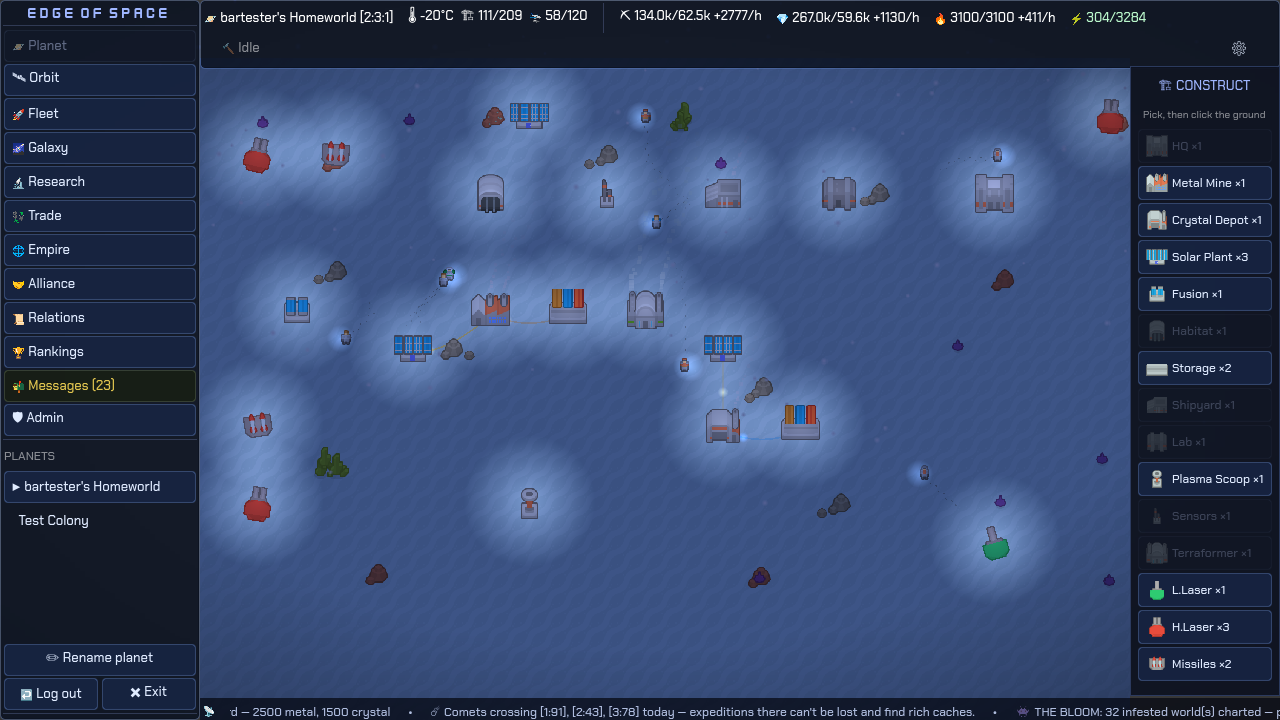
Next time, what happened when the Universe stopped being empty.
You can play Edge of Space for yourself at eos.simontasker.co.uk.