Game Dev · · 4 min read
Edge of Space, Part Five: Land Becomes Currency
The mine carpeting exploit comes home to roost in Edge of Space, so the ground got ore deposits, every extra copy of a building got dearer and fleets started burning fuel.
Nobody was upgrading anything#
Two posts ago I said that making buildings physical would create a brand new category of balance problem, and then I left it there ticking. This is the post where it goes off.
The game had been running for a while at this point with real placed buildings, a live bot population and me feeling quite pleased with myself. Then I sat down and actually looked at how the bots and I were playing, rather than how I assumed we were playing.
Nobody was upgrading anything. Not one of us, not ever.
The carpet.#
The maths behind it was depressingly simple. Every copy of a mine cost the same flat price, and a brand new level one mine paid for itself in minutes. Upgrading an existing mine to level twelve cost a fortune and gave you a fairly modest increase, while dropping a twelfth mine on an empty tile cost pocket change and gave you the same income again. So the winning strategy, and I do mean the only rational strategy, was to cover every buildable tile on the planet in cheap level one extractors and never think about any of them again. I ran a forty eight hour economy simulation to be sure I wasn't imagining it and sprawl beat depth by nearly four to one.
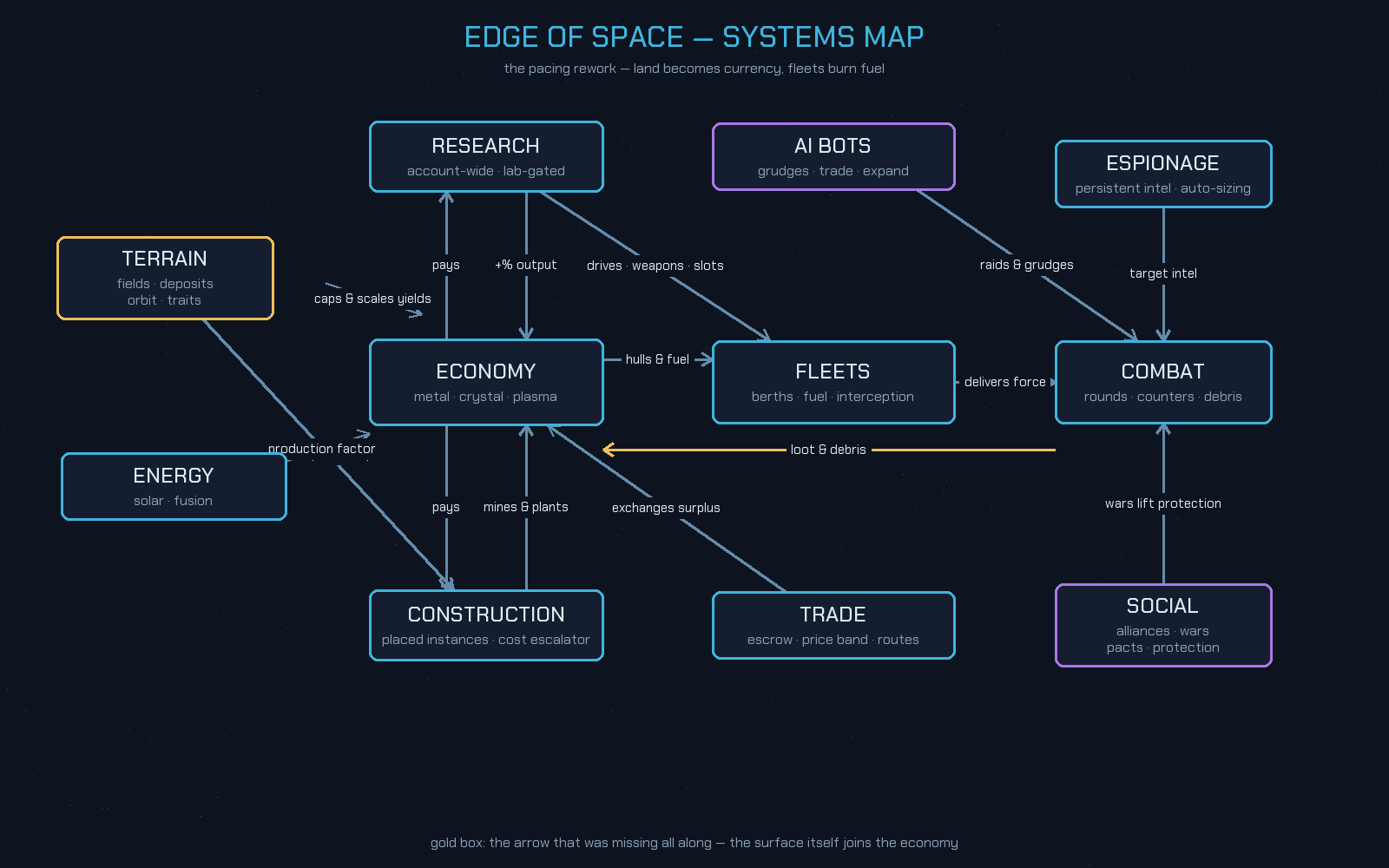
The part that still amuses me is that this bug could not have existed a month earlier. In OGame a mine is an abstract level on a page, there is no ground, so there is nothing to carpet. The moment I gave mines a footprint the surface itself became part of the economy, and as I went on about at length in the design document post, that was an arrow nobody had drawn. Now I had to go and build it for real.
Three fixes and one idea.#
All three of the fixes are the same idea wearing different hats, which is that the land is part of the economy so the land should do some of the balancing.
The first one is ore deposits. Metal mines can now only be built on an actual ore deposit, the copper brown rock formations you can see scattered across the surface, and they are rolled per planet so they are always in the same place for everyone. A planet might have two of them or it might have six, and that number is your mine cap, there is no arguing with it. Crystal works the same way through its outcrop clumps. All of a sudden the terrain of a planet is intelligence worth having, the galaxy screen shows deposit counts on empty worlds, and picking where to colonise became a real decision instead of a coin flip. The inner worlds are rich in ore and sunlight, the cold frontier is where the crystal is, so the map finally has a geography instead of just coordinates.
The second is the price escalator. For anything that isn't already capped by the terrain, each additional copy of a building costs one point nine times the one before it. The second solar plant is fine, the tenth costs roughly three hundred times what the first one did. Upgrades kept their old cost curve, so depth beats sprawl at last, the simulation agrees, and the carpet is dead.
The third one is the same disease in a different system. Nothing whatsoever was stopping an established economy from stockpiling an infinite number of ships, so now every hull takes up berths in your hangar and your shipyard level decides how many berths you have. A light fighter takes one, a World Ender takes twenty. Surplus income has to go somewhere, and now it goes up the tech tree instead of into an ever growing wall of the cheapest fighter in the game.
The third resource.#
Then, because apparently I cannot fix one economy without starting another, plasma arrived. A third resource, produced by skimmer buildings that want as much sunlight as they can get, and burned as fuel by every single fleet launch. The whole round trip is paid up front, and there are no refunds if you change your mind halfway there.
Fuel changed the shape of the map more than anything else in this post. Distance costs something now, so raiding your neighbour is cheap and raiding across the galaxy is a logistics exercise. Frontier colonies, which as I said is where all the crystal is, sit out in deep space where skimmers barely work, so they live on fuel shipped out to them from the inner systems. Nobody designed that as a feature. Supply lines just appeared, freighters hauling plasma outwards and crystal back in, and the trade routes players set up now have a reason to exist beyond me hoping they would.
The lesson#
Every fix in this post is the same fix. Find the thing that was secretly free and put a price on it.
Land was free, so mines sprawled across the whole planet. Berths were free, so fleets bloated into the thousands. Distance was free, so the galaxy may as well have been one room. A strategy game is only ever as interesting as its scarcest resource and I had been quietly giving away the important ones.
Next time, with the economy finally behaving itself, I got to do the fun part and give the Universe a pulse. Daily events, weekend wars, a comet that keeps a timetable, and something alien stirring at the edge of the map.
You can play Edge of Space for yourself at eos.simontasker.co.uk.