Game Dev · · 4 min read
Edge of Space, Part Four: The Empire You Can Watch
The Command & Conquer half of Edge of Space finally arrives, buildings you place on real ground, miners who walk to work, weather, and a sky that gets dark.
An OGame you can watch#
Right back in part one I said the idea was an OGame you can watch. For the first stretch of development that was, to put it kindly, aspirational. Buildings were levels in a menu, the planet was a picture behind them and the only thing you could watch was a progress bar. I had built OGame with extra steps and none of the watching.
This is the post where the other half of my childhood, the one that spent all those nights on Command & Conquer, finally got paid.
Buildings become places.#
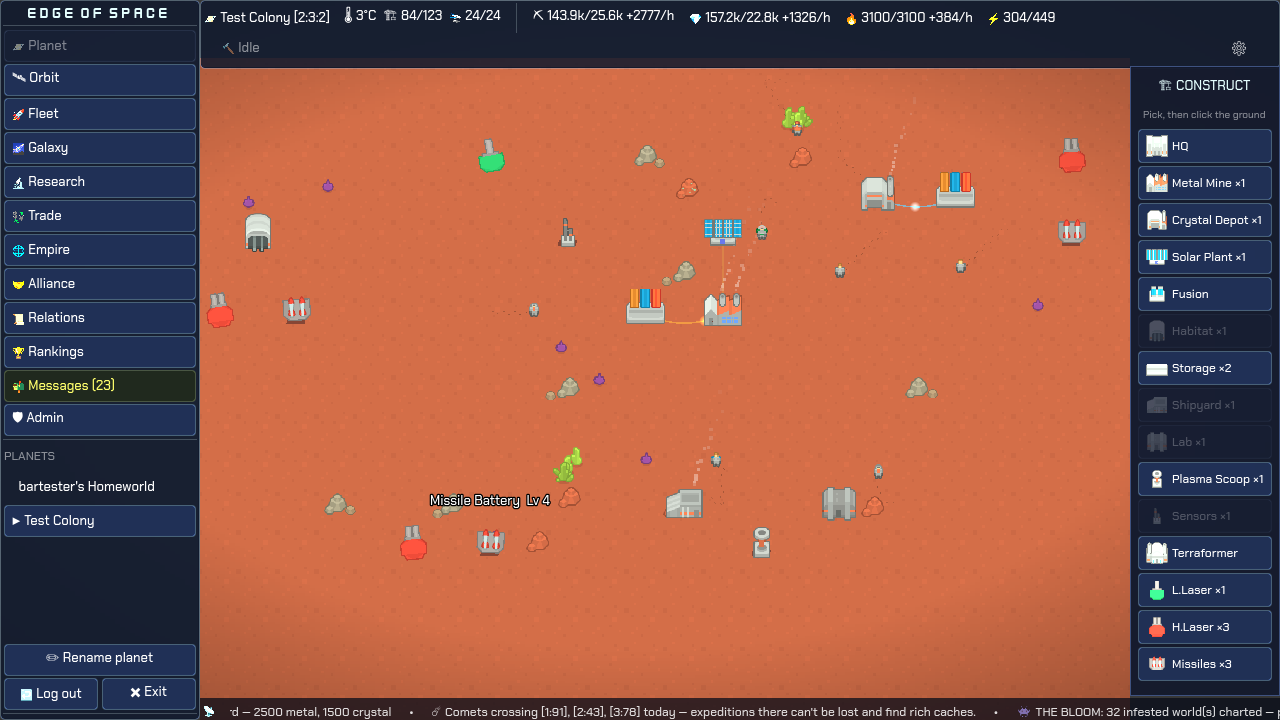
The change underneath everything else in this post is that buildings stopped being entries in a list and became structures placed on a real surface grid. You pick what you want from the construct panel, a ghost of it follows your cursor around and tints green or red depending on whether it will fit, and you click it onto actual ground. The server checks the spot is legal, because this is still an authoritative multiplayer game and the client only ever asks politely, and then a construction site appears exactly where you put it.
That one change went everywhere. A planet could now be full, so surface space turned into a real constraint instead of a number called fields that nobody ever looked at. Two players' homeworlds started to look different from each other because they had made different decisions about where things go. It also created an entirely new category of balance problem that took me weeks to notice, but that is the next post and I am going to leave it sitting there ticking.
Each copy of a building levels up on its own as well, so your first metal mine and your fifth are separate structures with separate upgrade buttons. That felt right for a game about a surface. You don't upgrade mines in the abstract, you upgrade that mine, the one over by the ridge.
The surface comes alive.#
With real positions on a real surface, all the things I had been quietly wanting to build became possible, and I got a bit carried away.
There is a day and night cycle now, a sun that sweeps across the sky on a real cycle and is synced to the server clock, so every player looking at the same planet sees the same evening at the same time. Buildings cast shadows that stretch and swing round as the light moves, and when it gets dark their windows light up one at a time. The outer worlds sit too far from their sun to ever really get morning, so they live in permanent night, which started life as a rendering detail and turned into the mood of the entire game.
The workers came next. Harvester crews travel between the depot and the crystal outcrops, actually carrying things and actually stopping to gather them. Citizens wander between buildings on errands of their own. When a hostile fleet is inbound the citizens run for shelter, which turned the attack countdown from a number in the corner of the screen into a small visible panic.
Weather arrived at the same time. Rain on the temperate worlds, snow where it is cold, nothing at all on the scorched airless rocks. It is deterministic, worked out from the planet and the clock rather than stored anywhere, so everybody watching sees the same storm roll through and none of it costs a single byte of network traffic. That trick, working things out from the time instead of syncing them, turned into one of my favourite tools in the whole project and it comes back later in a much bigger way.
Orbit got the same treatment. The old static fleet list became a place you look at, your actual ships drifting across the sky above the planet with one sprite for every docked hull. When the assembly bay finishes a fighter it climbs up off the surface on an engine trail and joins the traffic up there. When somebody raids you, the raiders sweep in and the sky fills up with laser fire. That part is pure theatre, the real battle is resolved server side in cold rounds of maths, but you would be amazed what eight seconds of theatre does to how a battle report feels when you read it afterwards.
The lesson#
Here is the part I did not expect. Almost none of this touched the rules of the game. The economy ticked at the same rate, the queues were the same queues, the combat maths didn't change at all. By the numbers, this whole stretch of work was decoration.
It changed the game completely.
Bots and I, because there still weren't any real players, defend a place differently to how we defend a row in a spreadsheet. Watching a construction site with a timer over it feels different to watching a progress bar in a menu even though it is the same timer counting the same seconds. I had always filed game feel under things that matter to platformers and shooters, the games where you can feel the controls in your hands. It turns out a slow strategy game where nothing happens for hours at a time needs it just as much, and possibly more, because the atmosphere is the thing you are logging in for.
The spreadsheet got up and started walking around. Next time, the bill arrives, because the surface became real and my economy hadn't noticed.
You can play Edge of Space for yourself at eos.simontasker.co.uk.