Game Dev · · 6 min read
Tiny World: Villagers who remember, carry and build
Villages that grow on their own, villagers who remember what they have seen and pass it on, and the rule that nothing in this world appears out of thin air.
A village from nothing#
A village in Tiny World starts as a small band of settlers looking for somewhere to stop. Near water, near trees, near stone, on flat ground. They lay out a square and start building.
As they grow they add houses, a woodcutter's hut, a quarry, a sawmill, farms, a fishery, a hunter's lodge, a smithy, a kitchen, a bakery, guard posts and towers, storehouses and eventually a village hall.
Nobody wrote that order down. Each village works out what it is short of, food or wood or stone or tools or room, and builds or staffs accordingly. Two villages from the same seed end up looking quite different because the land around them is different, which is exactly what I was hoping for.
Everyone has a job, and a memory.#
Every villager has a job, a home, an age and a memory, and the memory turned out to be the heart of the whole thing.
When a villager sees something, wolves to the south, a goblin camp by the lake, deer in the birch grove, they remember what it was, where, when, who told them, and how sure they are about it. They pass it on when they meet somebody. Memories fade. Second hand news is held less confidently than something seen with your own eyes.
A surprising amount falls out of that for free.
A hunter who saw deer goes back to where the deer were. A guard who spots something runs to report it, and once a village has a crier it gets announced to everyone, so people hide indoors while the guards go out. And when a player talks to a villager they hear what that villager actually knows, which is not a scripted line and is occasionally wrong, because the person telling you heard it from somebody else two days ago.
Nothing appears out of thin air.#
Early on, wood simply appeared in a village's stores the moment a tree was felled. It worked perfectly and it looked dead.
So there is one rule now and we have stuck to it. If something moves, somebody carries it.
This is the clearest example I have of how the two of us work on this. That rule is one sentence to say and it is enormous to implement, because every single thing in the world that used to be a number going up is now a person walking somewhere with an armful of something. I said the sentence. Claude Code paid for it, over about two days, and then I spent a week finding out what it had broken.
Saying the expensive sentence is easy when you are not the one typing. I am aware of that, and I would still make the same call, because here is what you get for it.
A woodcutter fells a tree, picks up the logs and walks them back to the hut. A builder fetches planks from the stores, carries them to the site, and cannot build ahead of what has actually been delivered. Building plots get cleared first, trees by the woodcutter and boulders by the stonecutter. Timber for a palisade or a bridge is hauled out to where it is needed.
It costs an enormous amount of walking, and walking means pathfinding, and pathfinding means bugs. It is also the single biggest reason the world looks alive. You can follow any villager on screen and work out why they are going where they are going, which is not true of a game where the stores just tick upwards.
Roads that get worn, not drawn.#
No designer places a path. Feet wear the grass into trails, trails nobody uses grow back over, and a village that gets past about ten people builds a proper road to its nearest neighbour along the cheapest route it can find. Where that road meets a river it becomes a bridge, and the bridge costs timber like anything else.
Bigger villages raise a palisade, with gates where the paths cross it and guards on the gates.
Palisades were harder than they look. A wall that runs down to a river and stops is not a wall, because anybody can wade round the end of it, so they follow the river bank now. And after leaving it running unattended one night I decided some villages should not have one at all. A village spread out along a river, or one that has sprawled too far too quickly, relies on its guards instead, which is both more honest and more interesting to watch.
Torches, lit by hand.#
At night the island goes properly dark and every building has a torch by its door. The first version turned them all on at dusk. That looked fine for about a minute and then it looked fake.
Now a village burns half a log for each torch it lights, and two of the guards walk round at dusk lighting them one at a time. If wood is short the crier announces a dark night and the rest stay unlit. The dwarves do the same round their hold, one dwarf going building to building before the rest go below for the night.
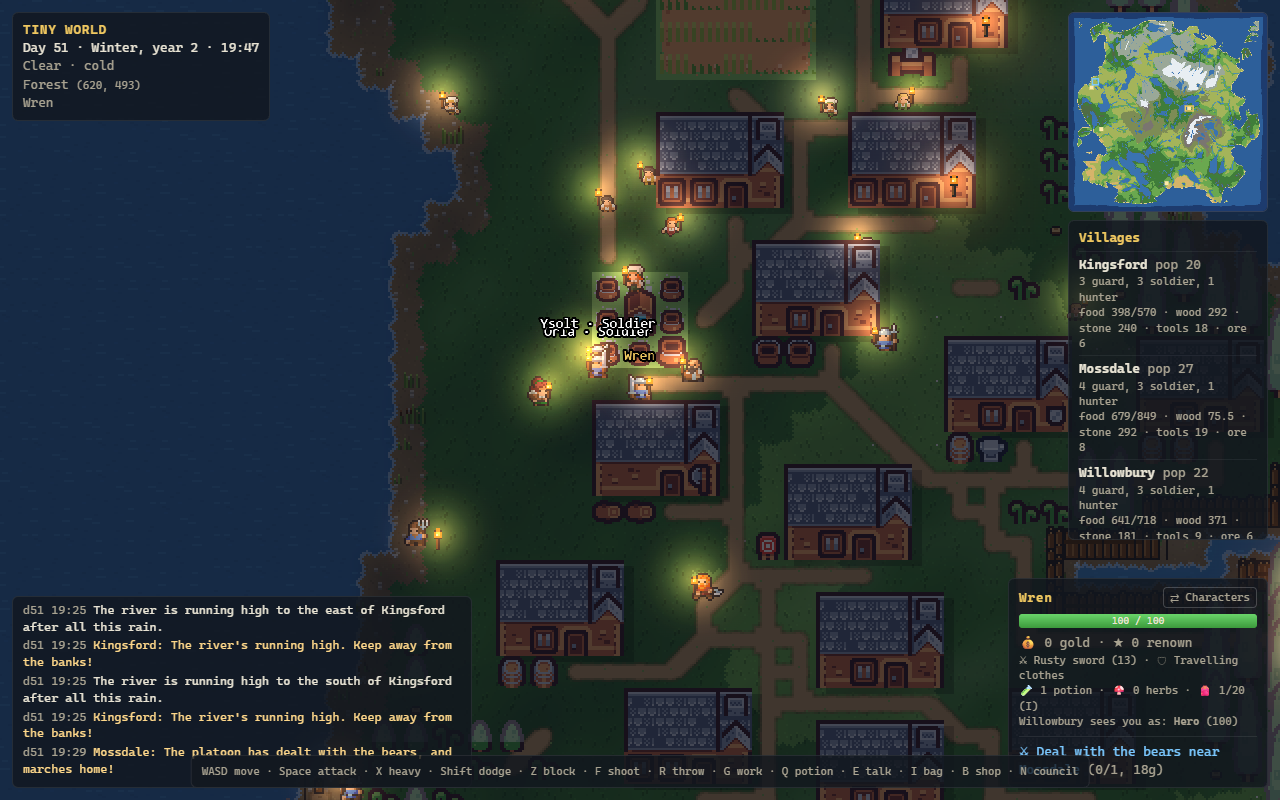
The first time I watched the light spread slowly through a village as a guard walked his rounds, it was one of those small moments where the whole thing stopped being a program.
Tools, trade, and a problem I made for myself.#
A village needs tools to fell trees and cut stone properly. Tools come from a smith, the smith needs ore, and ore comes from a mine that can only be sunk into solid mountain rock. A village with no mountain nearby has to trade for them.
Traders carry surplus, wheat or fish or planks, to a village or a dwarf hold, and come back with what is needed. They only trade with places they have actually heard of, from their own wanderers or from a passing minstrel, so trade routes spread the way news does.
One decision from this stage had consequences I did not see coming at all.
The character art does not have every job in both male and female versions. There is a male spearman for guards, for instance, and no female one. Rather than have somebody walking about in the wrong clothes, we made the rule that you can only take a job there are clothes for.
Weeks later in game time, that turned out to be why some villages could not staff their quarries, or their traders, or their soldiers. With half the village being children, the men only jobs were soaking up every grown man in the place. Some of it got fixed with new artwork, a woman trader in a green dress and women in the platoon. The rest is still a limit I am living with.
An art decision became a game balance decision, by a route nobody would have predicted, and I think that is my favourite thing that has happened on this project so far.
What was already wrong#
People kept swapping jobs, and therefore clothes, every few minutes as the village reshuffled itself. They settle into a job for a while now before they can be moved.
Hungry villagers ate wherever they happened to be standing. They go home to eat.
And a route planned before a new building went up could leave somebody circling forever, which is the flip flopping problem from the last post wearing yet another costume. Blocked routes get planned again.
Next time, everything else that lives on the island, which by this point includes several things that want to eat the villagers.