Game Dev · · 6 min read
Tiny World: Everything else that lives on the island
Wildlife with its own appetites, weather that floods rivers, three diseases including one that raises the dead, and the goblins, dwarves and elves sharing the island.
Animals that are not scenery#
Deer, rabbits, boar, foxes, wolves and bears all have hunger, thirst and an age. The herbivores browse, and what they browse includes the flowers and the village crops. Wolves hunt in packs, bears are territorial, everything breeds and everything eventually dies of old age.
The parts I find interesting are the restraints rather than the behaviours. Wolves only go for people when the pack outnumbers them. Animals stay out of villages unless they are starving. And a bear will let somebody who is running away from it go.
That last rule came out of watching the live world overnight. Guards were fighting bears to the death, every time, because neither side had any concept of giving up. Now a badly hurt guard falls back and the bear lets him. Across twenty test fights, guards survived thirteen of them instead of seven.
Weather, and then the proper disasters.#
Rain, storms, snow and fog move across the island as fronts, slowing people down and feeding the plants. Enough days of rain and a river rises and bursts its banks, and then everybody wades slowly through the flood until it drains away.
On top of the weather there are rarer events. Wildfires that spread through dry woods and burn themselves out. Earthquakes that damage buildings. Locust swarms that eat into the stores. Droughts. A damaged building stops working until builders repair it with fresh materials.
That last detail produced my favourite cascade so far. A quake wrecked every building in a small village, the farm included. The village had exactly one grown man, and he carried on chopping trees with a hundred and fifty logs already in store, because chopping trees was his job. Nothing got rebuilt. The village starved to death surrounded by timber.
Builders now come first whenever there is wood in store and buildings waiting, which is an obvious rule that only becomes obvious after you watch a village starve for want of it.
Colds, plague and the dead that walk.#
Three diseases. A cold does the rounds in autumn and winter and is mostly an inconvenience. Plague spreads between people standing close together and kills. And the zombie plague comes from a bite, and its victims get back up as undead versions of themselves wearing the same clothes, because we made a zombie twin of every single sprite.
Villages fight back with herbs. A gatherer brings in healing flowers and somebody doses the sick.
The overnight run found the hole in that. A village with a farm and full larders has no reason to keep a gatherer, so when plague arrived there was nobody whose job it was to go and pick anything. Three children died with the cure growing in the meadow outside.
Now an outbreak puts a gatherer to work immediately after the guards, searching further afield for flowers and mushrooms. In test outbreaks that took deaths from nine down to three.
And then, about one day in four hundred, a green star falls. It leaves a cursed relic out in the wilds that withers everything around it, gives anything that comes near it a terrible hunger, and raises the dead. I am not going to explain it any further than that.
The island is not only villages.#
Goblins live in camps that grow, spread new camps, size up a village before raiding it, and carry off plunder, which draws more goblins.
Dwarves dig holds into the hills. Their miners bring home stone and ore, the hold raises stone buildings around its entrance, and its fighters stand guard outside them during the day. There are nine kinds of dwarf in the art, from the king down to the riflemen on the watchtowers, and one who rides a bear.
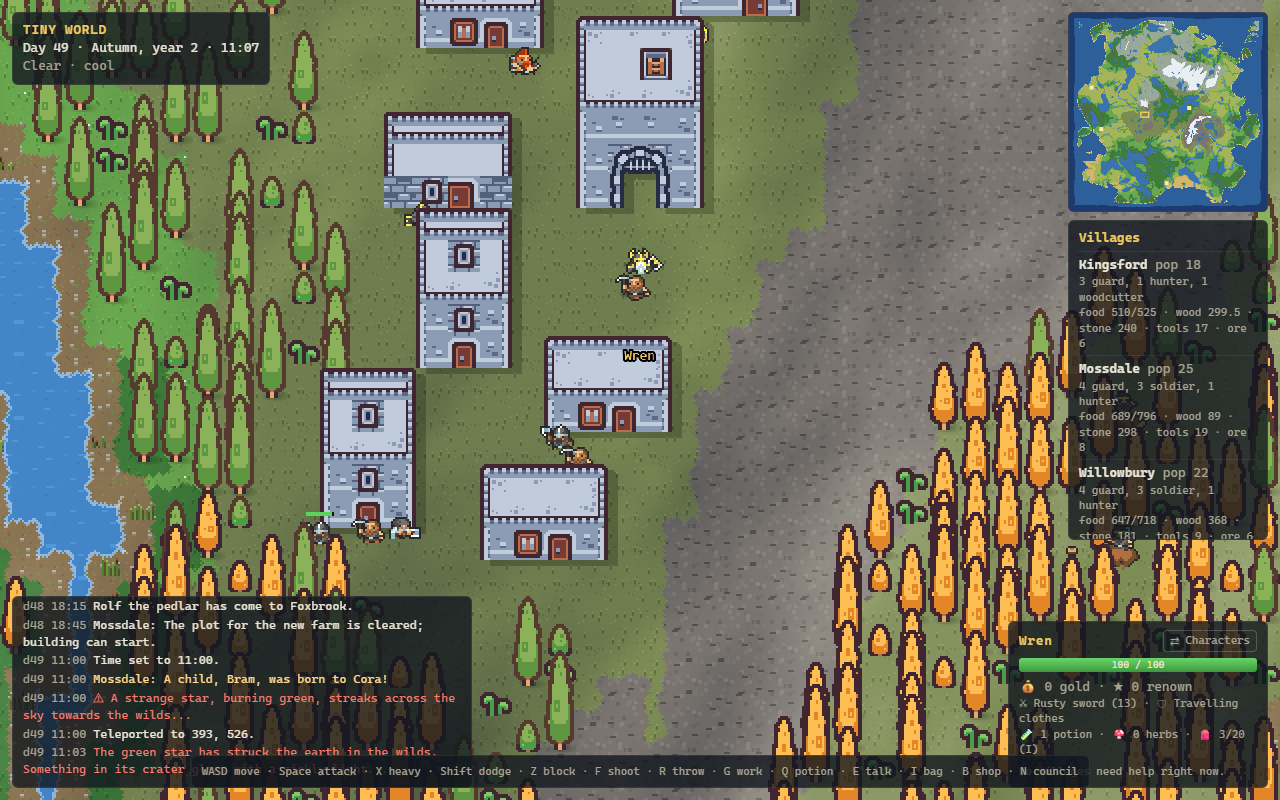
Slimes wander about and split into smaller slimes when you kill them, which is the oldest joke in games and still funny.
Elves live in groves deep in the woods. They keep their forest, so no village will fell a tree there, they see off goblins, and their mages come out to draw the zombie plague out of a village's sick.
Travellers walk the roads. Pedlars sell what is wanted and buy what is spare. Minstrels sing about the places they have been, which is how villages find out that other villages exist. Pilgrims tend the sick.
And bandit gangs camp in the woods and waylay travellers. They rob rather than kill, and new outlaws are villagers who deserted a hungry village, which means banditry is something the world produces rather than something I place.
Where new people come from.#
This was one of the more satisfying decisions on the project.
At first people simply appeared when a village needed them, which works and quietly ruins everything. So there are two rules now.
Everyone arrives on the island by sea. The first settlers come ashore and walk inland looking for a spot, and later newcomers arrive the same way when the island is short of villages.
After that, new people only come from births. Villagers, goblins, dwarves and elves all have young and the young grow up. If a village loses its guards, the next guard is somebody's child coming of age.
That makes population mean something. A village that loses too many people to wolves cannot simply refill itself, and a small village that keeps shrinking is eventually abandoned, with the last few walking across the island to somewhere that is thriving.
It also caused the main problem of the overnight run. Births pause while the children outnumber the adults, and childhood was long, so villages stalled at about sixteen people for weeks of game time. Shortening childhood from about thirty three game days to twenty five let them reach the low twenties.
Standing platoons.#
Once a village reaches twenty people it keeps a standing platoon. Soldiers who march out together against anything too big for the guards, a wolf pack or a bear or a bandit gang, and then march home again.
It took three attempts to make that real. The first version gave a big village a platoon of one, because every adult was already doing another job. Then settlers leaving to found new villages kept taking the entire platoon with them, which is exactly what soldiers would not do. Now a platoon is at least three, settlers only leave a village of twenty eight or more, and soldiers never go with them.
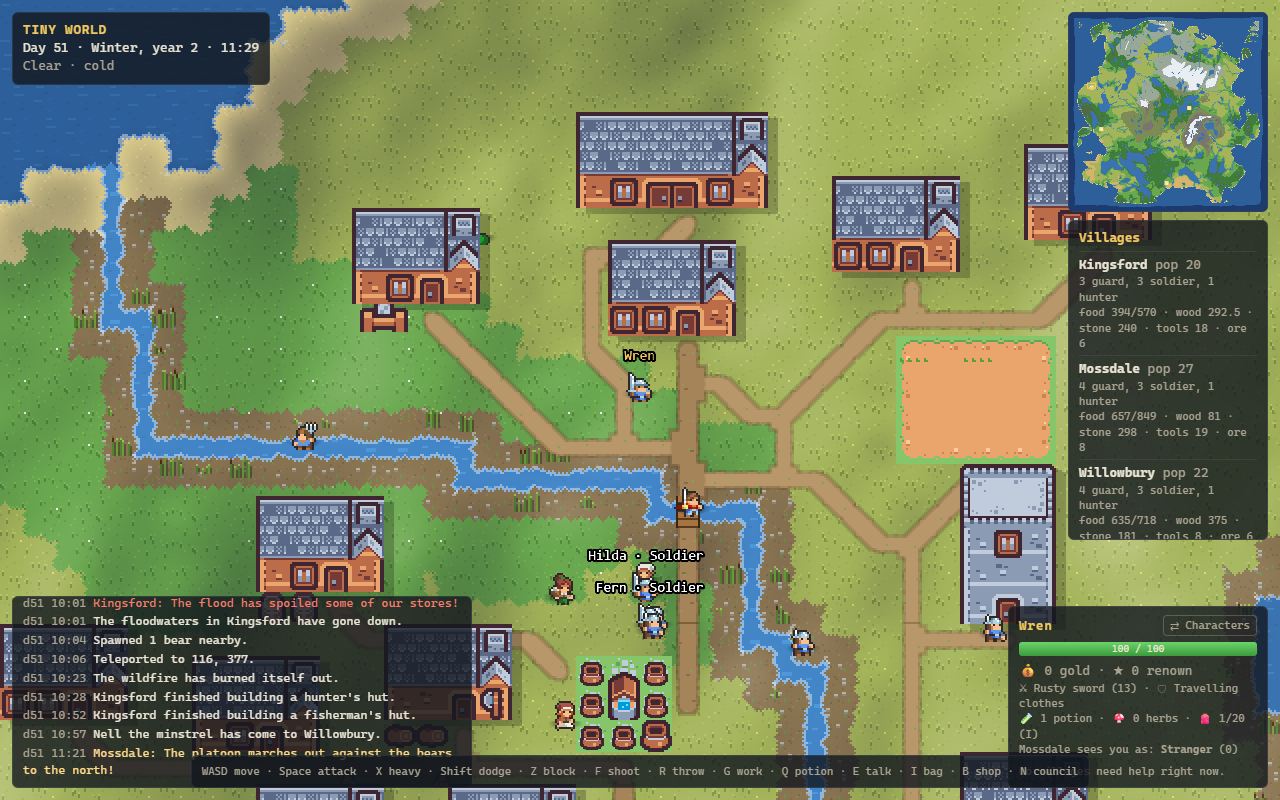
In the live world the first platoon marched out against bears on day forty eight and came home again. A few days later another one, two of its soldiers women, which had only just become possible after the clothing problem from the last post, wiped out a bandit gang shortly after it formed.
That clothing rule is worth one more sentence, because it is the other half of how this project gets made. I set a rule for a reason that was purely about how the game looks, Claude Code implemented it exactly as asked, and then neither of us thought about it again until villages started quietly failing to staff their quarries a fortnight later. Nothing was wrong. Everything did what it was told. The consequence was simply three steps further down the line than anybody was looking.
Next time, letting actual people into it, and what a world running overnight tells you that no test ever will.