Game Dev · · 5 min read
Dead Tide: A zombie survival game in a day
A browser multiplayer zombie game in the style of Zero Sievert, built and put online in a single day, and why the first version looked nothing like the one people are playing now.
The idea#
I have wanted to make a zombie game for a long time, and I have been playing a lot of Zero Sievert. It is top down, it is slow and tense, and every trip out feels like it might be your last. That is the feeling I wanted.
So the brief I wrote at twenty six minutes past eleven this morning was this. A multiplayer zombie survival game, played in the browser, top down like Zero Sievert. Hordes of zombies with proper states, so they can be idle, wander, hunt, swarm, attack and explode. And the part I cared about most: if a zombie cannot get at you directly, it should go for the doors and windows of whatever you are hiding in.
It is called Dead Tide, and it is running at deadtide.simontasker.co.uk while you read this.
Who "we" is.#
Same as the Tiny World posts, and I would rather say it up front. When I say we, I mean me and Claude Code. Claude wrote the code and I decided what the game is supposed to be, I played it then said what was wrong with it.
That last part is most of the work. Looking back over the day, nearly every message I sent was a complaint. The gun sits too close to the head. The people on the train are jumping about. The cleaners are not cleaning up the blood. Each of those turned into a fix, and a lot of them turned into a whole system.
One day.#
I want to be honest about the timescale, because it is the reason this series exists.
The first message went in at 11:26 on Monday the 26th of October. By about half past seven in the evening the game was on my own server with real people able to log in. By ten at night it had a railway, a tutorial, a floating base with its own staff, scavenger camps, forward posts, squads, a war map, recorded sound and an art pass over every building on the island.
It is roughly eleven thousand lines of TypeScript across about fifty files, with a hundred and thirty sound effects. I did not type them. I am not going to pretend the interesting decisions in here are about code, either. They are about what a zombie does when it cannot reach you, and those were mine.
Why it looks like this.#
The first version was drawn entirely in code: coloured shapes, procedurally made textures. It worked, and you could play it, but it was not Zero Sievert and it was nowhere near the feel I wanted. I also wanted animation on everything.
At about half past twelve I pointed it at a free asset pack I had downloaded, the Stalker-like pixel art pack by BlackHunterDev on itch.io. That changed everything. The player sprite, modified and greyed out, became the zombies. The bandits became the hostile faction. Recoloured characters became the people still living on the island. The pack's UI pieces, including its inventory screen, became the menus.
From that point the questions stopped being about whether it looked like a game and started being about details. The gun was held too high and too close to the head. Every zombie had a backpack on, which is a lot of very organised zombies, so now only some of them do. At one point an entire sprite sheet was being drawn over the top of the game screen. And the mouse cursor was a huge thing that looked terrible, so it went.
The shape of it.#
It is TypeScript everywhere, for the same reason as Tiny World. A Node server runs the whole simulation twenty times a second and owns the truth about every zombie, door and bullet. The browser draws it.
The one clever thing is movement. The code that moves a player lives in a shared folder that both the server and the browser import. So when you press a key, your browser moves you straight away using exactly the same rules the server will use, and when the server's answer arrives the two agree. That is why it feels responsive even though the server is in charge.
The island itself never goes over the network. The server sends a seed, both sides generate the same island from it, and after that only the things that change get sent: a door opened, a window boarded, a crate emptied.
The island and the Ark.#
Every island has a city, two industrial sites, a couple of towns and a handful of villages, joined by roads, with a railway loop running round the middle. Buildings are split into rooms, with doors, windows, furniture and crates to search.
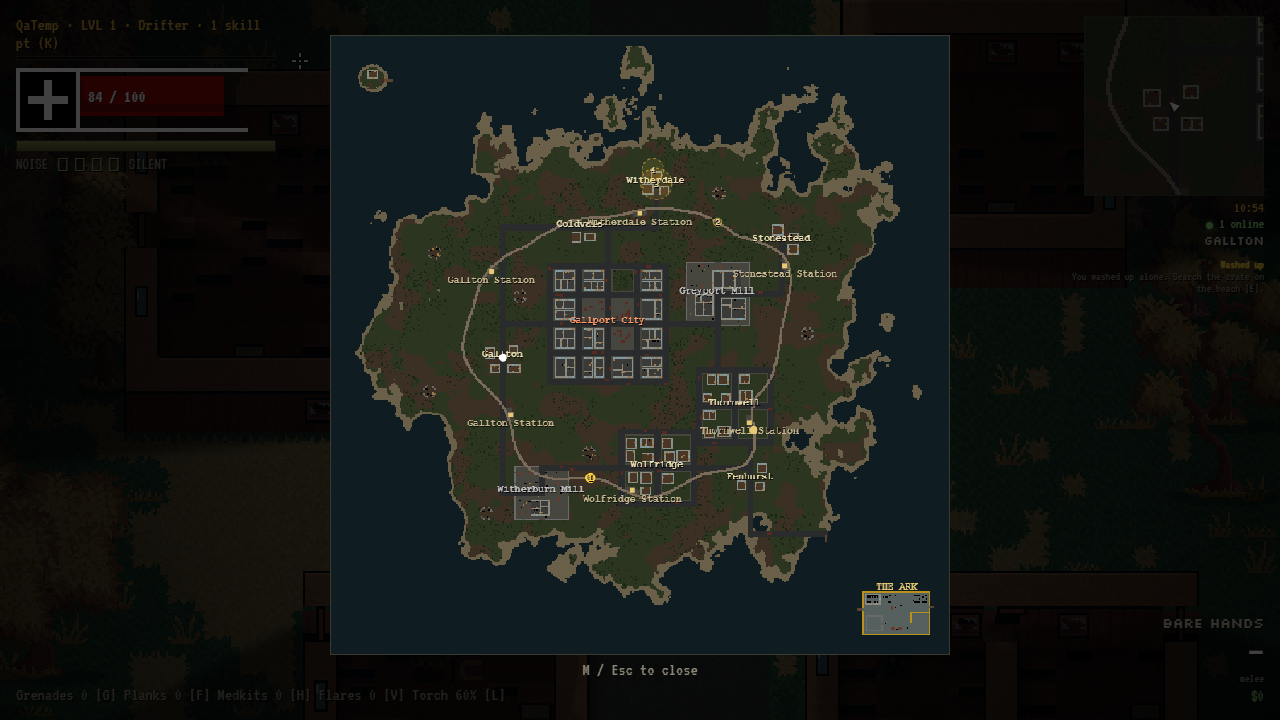
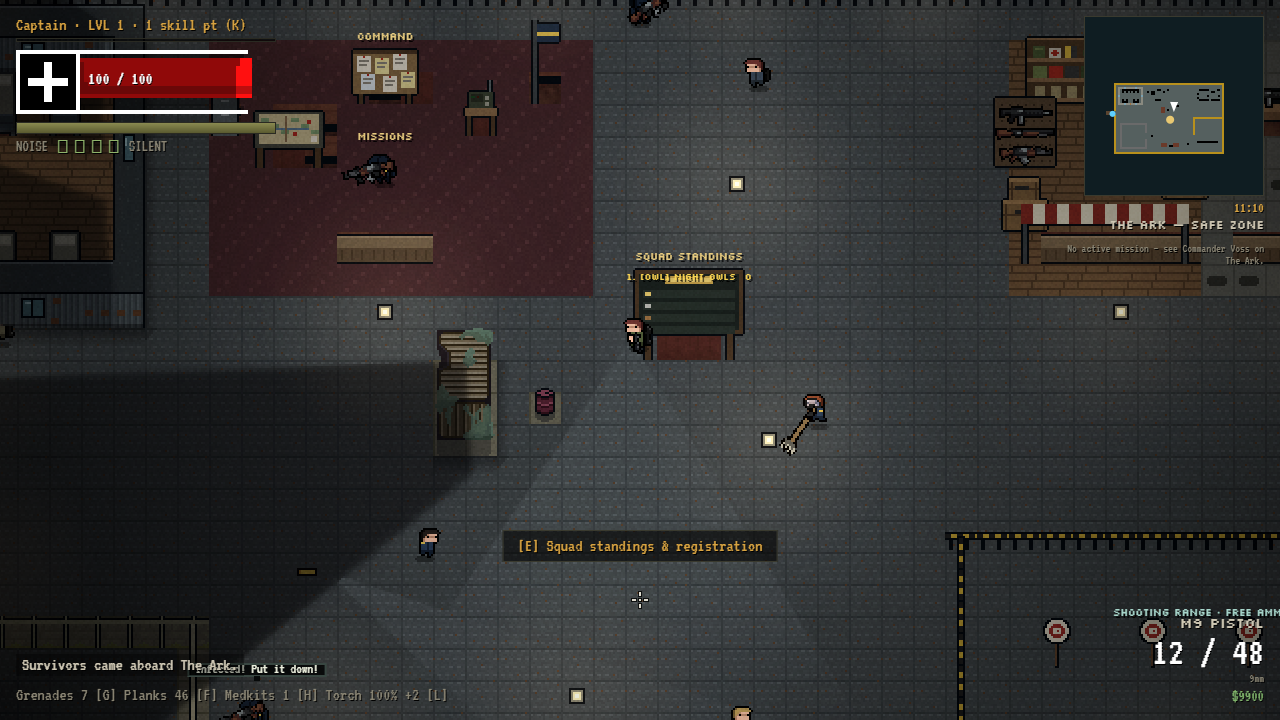
You do not live on the island. You live on The Ark, a floating base moored off the coast. That gave the game a home: somewhere safe to trade, take jobs, fix your guns and sleep, and a ferry ride between it and the dead. Most of the third post is about the Ark, because it turned into far more than a menu with a deck.
What was already wrong#
By lunchtime the list was long. Zombies walked straight through players, so a horde could never trap you; now they block movement, and getting cornered is a real way to die. The torch was off centre and not lined up with the gun. When you reloaded, the light swung about with the weapon. Now the aim and the torch come from where the gun is, not from the gun sprite itself.
And the menus opened anywhere on the Ark, which felt wrong. Now you have to walk up to the person and talk to them.
Next time, the zombies themselves, and the rule that made the whole thing work: they can hear you.