Game Dev · · 5 min read
Edge of Space, Part Three: The Universe Gets People
Edge of Space had planets, fleets and battles but nobody to fight, so my OGAME inspired game got AI commanders, alliances and an economy built out of wreckage.
An empty Universe#
There is a particular kind of quiet you only get in a multiplayer game with no players in it. Edge of Space had a working economy, fleets that flew where I sent them and battles that resolved properly, and it had three whole galaxies where absolutely nothing was happening. I would log in, check my planets, empty the build queue and realise that the only empire in the Universe that had done anything since yesterday was mine.
I had built a massively multiplayer game for one person.
OGame never had this problem because OGame had people in it. Thousands of them, circling each other, forming alliances and holding grudges for months. The game underneath all that was numbers going up, but the reason I used to check my fleets before work was that somewhere out there an actual human being was looking at my planet and deciding whether my defences looked thin enough to be worth the trip. That tension is the thing you are really selling. Everything else is a spreadsheet with a nice background.
So this stretch of development was about one thing, making the Universe feel lived in before there was anyone living in it.
The bots.#
The first decision was the biggest one. Edge of Space now seeds a full population of AI commanders when a server starts, with names like Xanthe, Oberon and Cassius, and they are not scenery. I set one rule at the start that shaped everything that came after it, the bots obey exactly the same rules and prices that you do. No free resources, no fleets that teleport, no seeing through the fog of the galaxy map. They follow build plans, they save up for things they can't afford yet, they research the same tech tree and they launch the same missions with the same flight times.
Each one gets a personality as well. Some of them are turtles who dig in behind rows of defence turrets and barely leave home. Some are traders who post their surplus on the market. The expansionists research their way to colony ships and start spreading, and the aggressive ones will send a probe at your planets to see what you are holding before they decide if you are worth raiding. When one of them does decide to raid you, you get exactly the same warning and the same countdown a human attack would give you.
I will admit that some of them cheat. A portion of the population gets double build speed or double income, because a fresh Universe full of honest bots takes weeks to become dangerous and I wanted the game to have some teeth on day one. It is a difficulty setting in disguise. The important part is that you can't tell which ones are cheating, and more to the point you can't tell the bots from the humans at all.
Somewhere to belong.#
People need somewhere to be people, so the same stretch of work brought in the social layer. Alliances with their own member chat, rankings that put bots and humans on the same board with no marking to tell them apart, and the least interesting feature of the lot which also happens to be the most important one, newbie protection.
If your empire is more than five times the size of someone else's, you simply cannot attack them. Without that rule a persistent game is just a machine for turning veterans loose on beginners until the beginners stop logging in, and I have watched that happen to games I loved.
The bots got seeded into their own alliances too, the aggressive ones under one banner and the turtles under another, so the rankings screen reads like a political map instead of a list of names. If a bot in your alliance wins a raid it will post about it in the alliance chat. The lines are canned, I am not pretending otherwise, but they only ever describe something that genuinely happened, so a human who joins one of those alliances walks into a society already going about its business.
War gets an economy.#
One more change from this era quietly rewrote what combat is for. Ships destroyed in a battle now leave a third of their cost behind as a debris field over the defender's planet, and there is a new ship, the Recycler, whose entire job is to go and scoop it up.
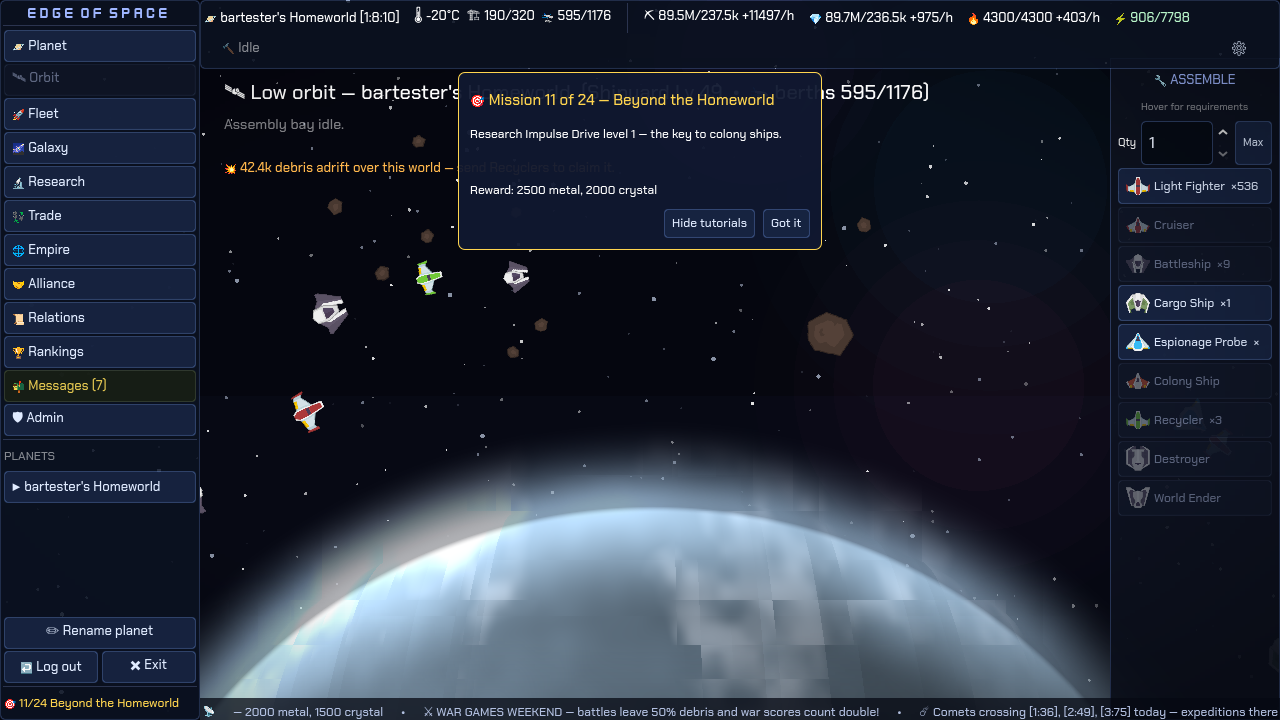
That sounds like a small feature and it is not. Before debris existed, losing a fleet was pure deletion. You put resources in, you got nothing back, and the only sensible thing a loser could do was log off and sulk. Once the debris was there, every battle started minting a prize that anybody could go and collect, including the loser, and including some third party who watched two rivals maul each other and turned up with a hold full of recyclers and no manners. War stopped being a hole you pour resources into and became an economy.
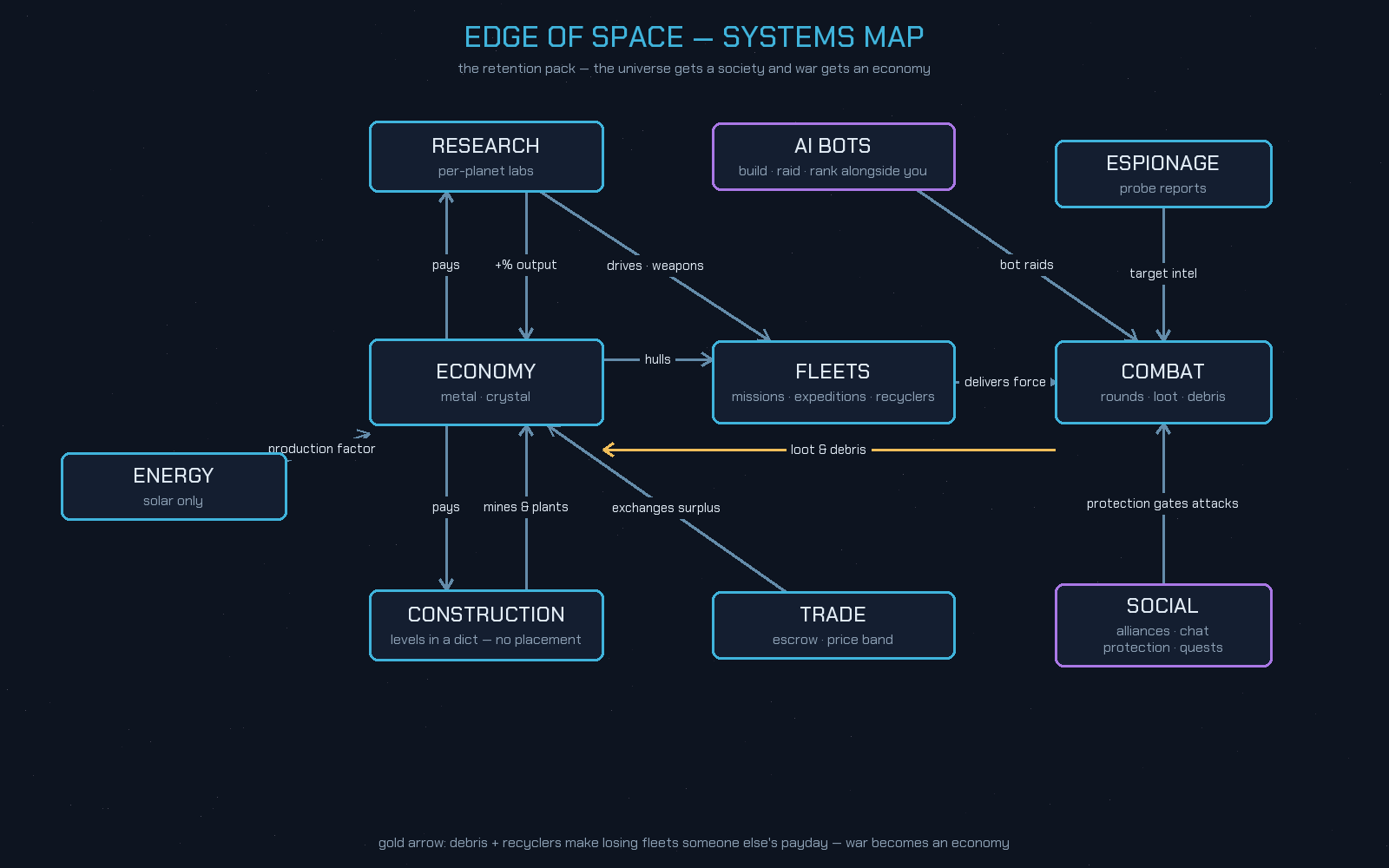
On the systems map this is the arrow from Combat back to the Economy, and I coloured it gold because it is still my favourite thing on the whole diagram.
What I learned#
A game is not multiplayer because of the netcode. It is multiplayer because when you log in, something has happened that you didn't do. The bots gave me that months before any real player could have, and because they play by the same rules as everyone else, every system they touched got tested to destruction for free.
They also found my balance problems the way players would have, which is to say by exploiting them without mercy and without telling me. More on that particular disaster in a couple of posts.
Next time, the other half of the promise I made in part one, making an empire you can actually watch.
You can play Edge of Space for yourself at eos.simontasker.co.uk.