Game Dev · · 7 min read
Tiny World: Lives worth following
Going from villagers who do jobs to villagers who have lives, with families, meals, winters that cost something, broken tools, moods and the odd act of courage.
Ten minutes with a woodcutter#
By the end of the first week you could follow anybody in Tiny World and work out why they were going where they were going. That was the entire point of making them carry things by hand.
Then I followed a woodcutter for ten minutes and had seen everything a woodcutter does. Fell, carry, sleep, repeat.
So this stretch was about giving people a life around the job, and the test I kept coming back to was simple. Pick somebody at random, follow them for a game day, and is there anything to notice?
One body, many people.#
The first obstacle was art rather than code, which is becoming a theme.
The character packs give you a sheet per trade. A farmer, a guard, a smith. That is why we had the rule from post two that you can only take a job there are clothes for, and why some villages could not staff a quarry.
The fix was a base body. An item free human with every animation, built by stripping the tools, armour and hats out of the existing sheets frame by frame, and then putting all of those back on as separate layers. A long run of commits went into cleaning that up, because stripping things out by hand leaves a sliver of helmet on the sword as he is hit, or a pinhole at the neck where the old head's beard used to be.
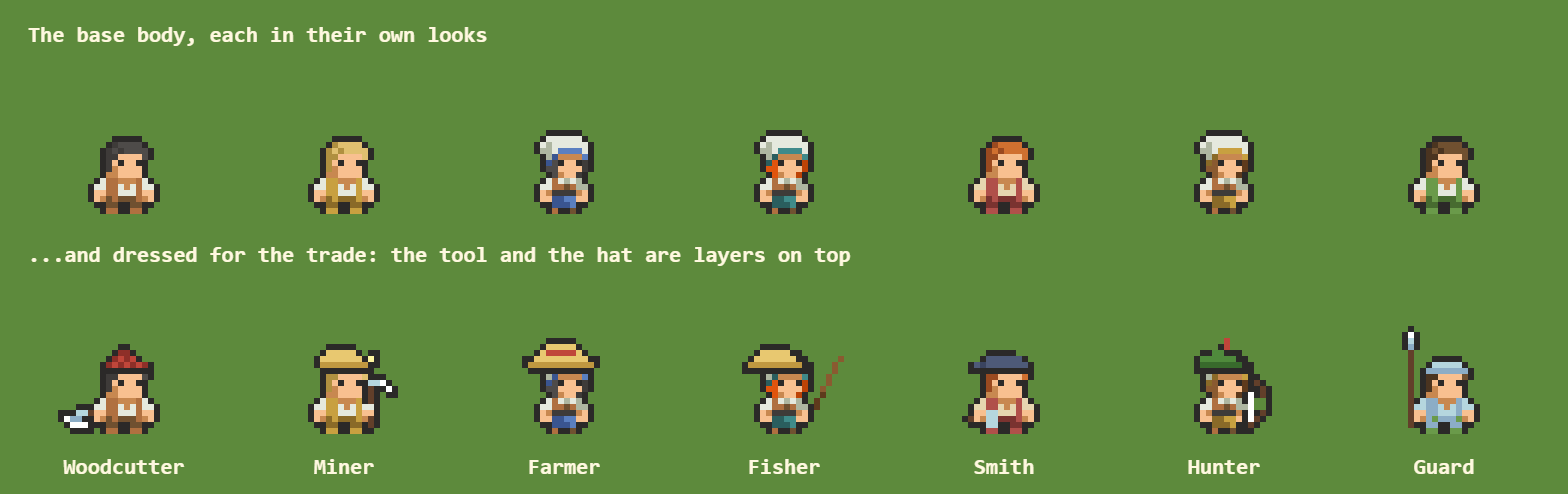
What that bought was worth every one of them.
Every trade now has a man and a woman in their own colours, so the clothing rule stopped being a staffing problem. Hats come by trade, the farmer's straw hat, the miner's lamp helmet, the woodcutter's bobble hat, the fisher's sou'wester, worn at work and taken off at the table and in bed, with a knitted cap in winter. Goblins got twelve looks with role headgear, and the dwarves, elves and outlaws each got four looks per role, so no two members of a gang look alike.
And a human player is now the base villager as well. A player chopping wood looks exactly like a villager chopping wood, which is the rule this whole project keeps coming back to.
Families, meals and water.#
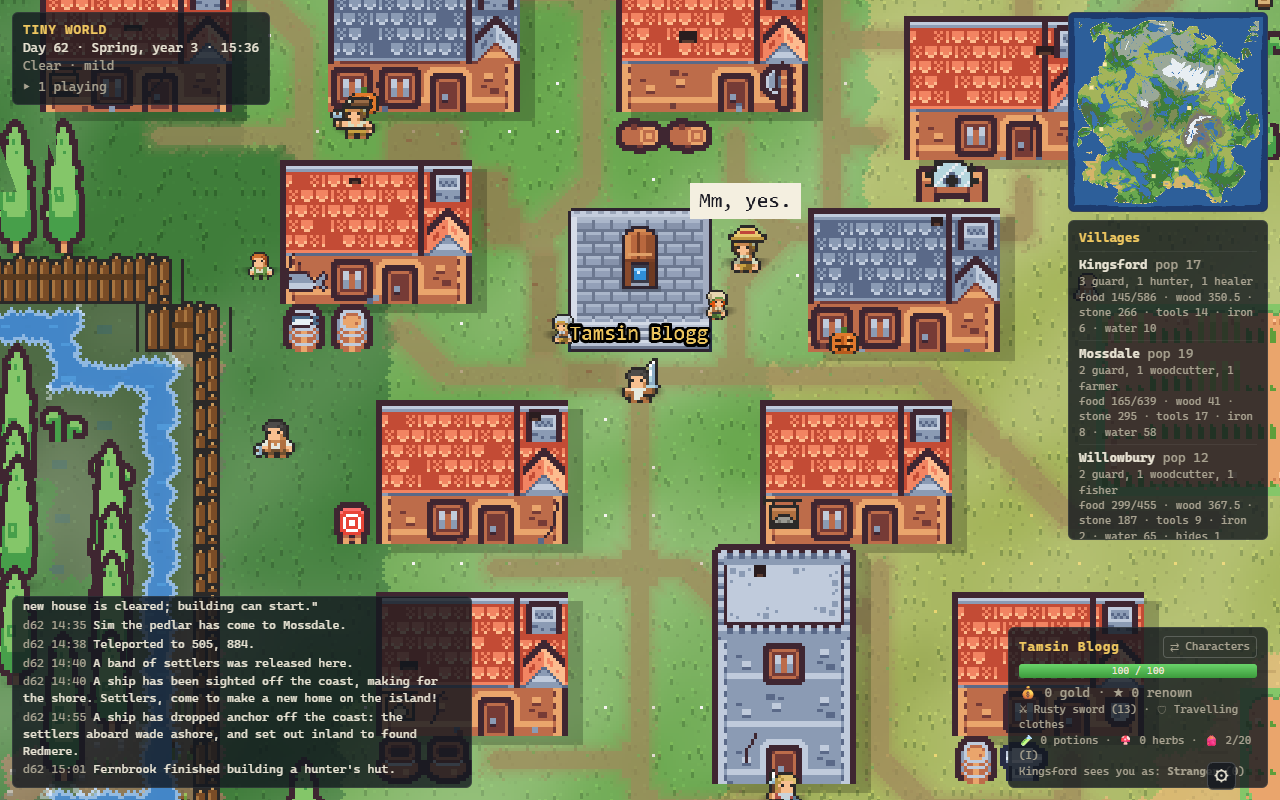
Villagers marry and set up home together now, each household in its own house, children living with their parents. Babies are only born to married couples with room at home, which means a village that stops building houses stops growing, and that is a consequence I like a lot.
They eat three meals a day at the square with a drink, which meant water had to become real. There is a well in the square, a water store, and water carriers keeping it full. Take the water away and thirst does what thirst does.
Courting came later. Two single friends grow fond of each other, walk out of an evening, and in time marry. Some couples grow cold and part. Two neighbours stop in the street, face each other and talk back and forth, and they remember what they said, so nobody repeats the same line to the same person for four days.
Winter that costs something.#
Winter used to be a colour change. Now it is a bill.
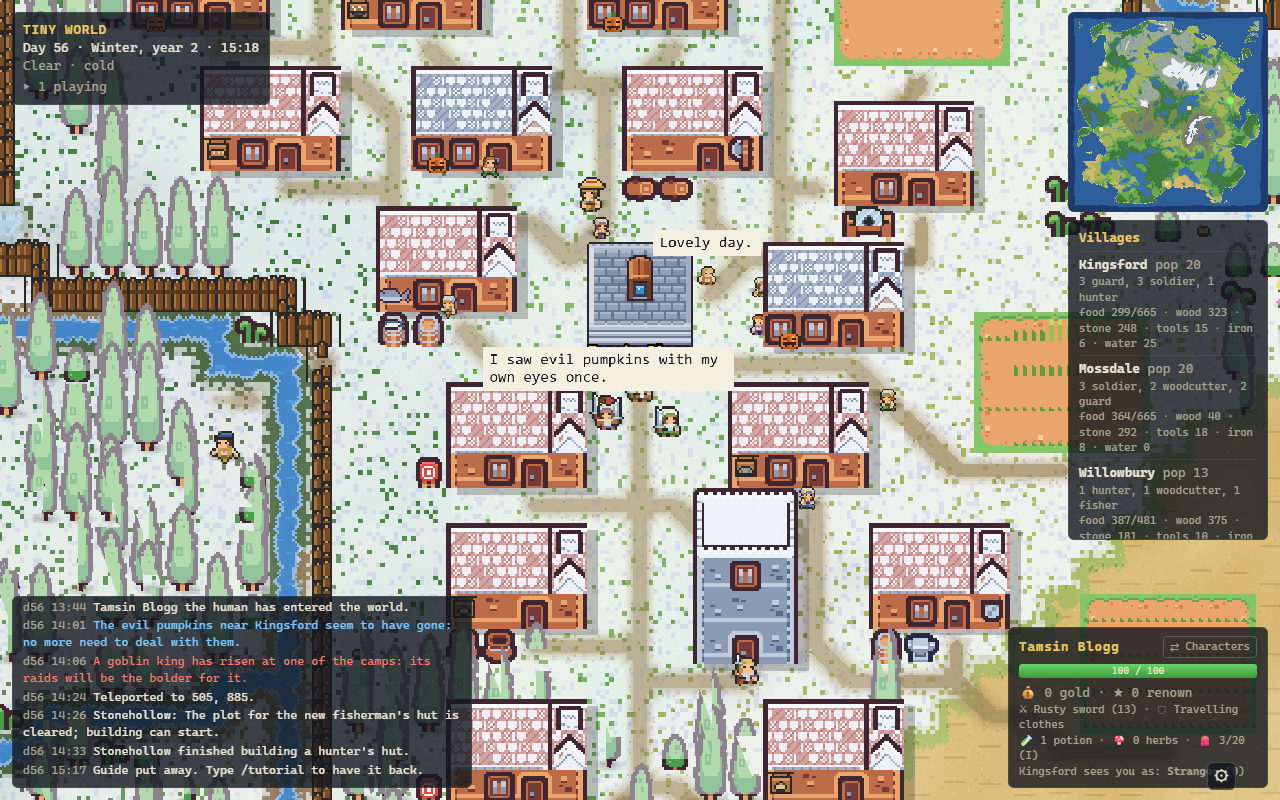
Houses burn firewood through autumn and winter, and with none left they go cold, and on a cold night somebody in a cold house may catch a chill or worse. The tailor sews warm coats from autumn onwards, and without one people shiver through the season. Lakes freeze, so the fishers walk to the sea or lay up their boats, the frost takes any green wheat, and in midwinter the children go skating on the pond. Anybody still out on that ice when it thaws goes through it.
The grass goes gold in summer and russet in autumn, and snow covers the ground and the roofs.
My favourite detail in the whole lot is that chimneys only smoke from houses with somebody at home, so you can tell the lived in houses from the empty ones at a glance.
Nothing stays new.#
Buildings wear, and builders mend them, and one left too long falls into disrepair and looks it. Tools break, and the woodcutter throws down the axe and fetches another from the stores, or goes without until the smith has made one. Clothes wear out and the tailor makes new ones from hides or flax.
People wear out too. There are injuries by trade, cuts and burns and sprains and broken bones at work, and wounds from fights, and they slow somebody's work and walking until they mend. There are summer fevers, worse near the marshes, and the flux from bad water or famine. So there is a healer's hut, and a healer who tends the hurt and the sick with herbs.
Natures, moods and nerve.#
Every villager has two traits that never contradict each other, and a body that changes with how they live. Hard work makes them fit and strong, idling and eating when they are already full makes them stout and slow. They have friendships and moods with reasons attached, grief for a husband or wife lost, joy at a wedding. Follow somebody and a panel opens with all of it.
And then courage, which is the part I did not expect to care about so much.
Somebody bitten by the zombie plague, who knows exactly what that means, says goodbye and walks out of the village alone. An adult cornered with no guard nearby goes down fighting. A hunter takes on a bear in the village with a bow and leads it away. Frightened villagers run in at their own front door and stay there while the danger is about.
None of that is scripted as a scene. It is what those rules produce, and watching it happen to somebody whose name you know is a different thing entirely from watching a health bar.
Towns, grudges and adventurers.#
A village of thirty with a hall becomes a town, which gets bigger stores and a market where traders do a little better, and its builders start rebuilding the houses in stone.
When goblins or bandits kill somebody, the village remembers which camp did it. It sends a survivor, one who actually saw it if any lived, to carry word to its neighbours, and their platoons march out to avenge the dead. When the camp is broken the crier says so.
And in a thriving village where every job already has its first worker, a youngster with no work takes up the sword instead. They practise at the square, take quests and bounties, buy forged gear and pay the smith to mend it. The island grows its own adventurers.
What was already wrong#
Ravenholt starved with four farms and one farmer, because the job list gave one person to each job before it gave anybody a second. A hungry village now fills its food jobs before anything else and its fields get their full crew at once.
A village where every man had died could not fell a tree, because only men had woodcutter's clothes. Now the women take up the axe in their own clothes, and a neighbour that can spare a young man sends one.
And somebody kept away from the square went hungry with a full larder thirty paces away. People get fed anywhere on village land now, and forage in the wilds if they are cut off entirely.
Next time, October arrives on the island, and so does something worse.